
Dominoes / Culture
What are the unwritten rules at a domino table?
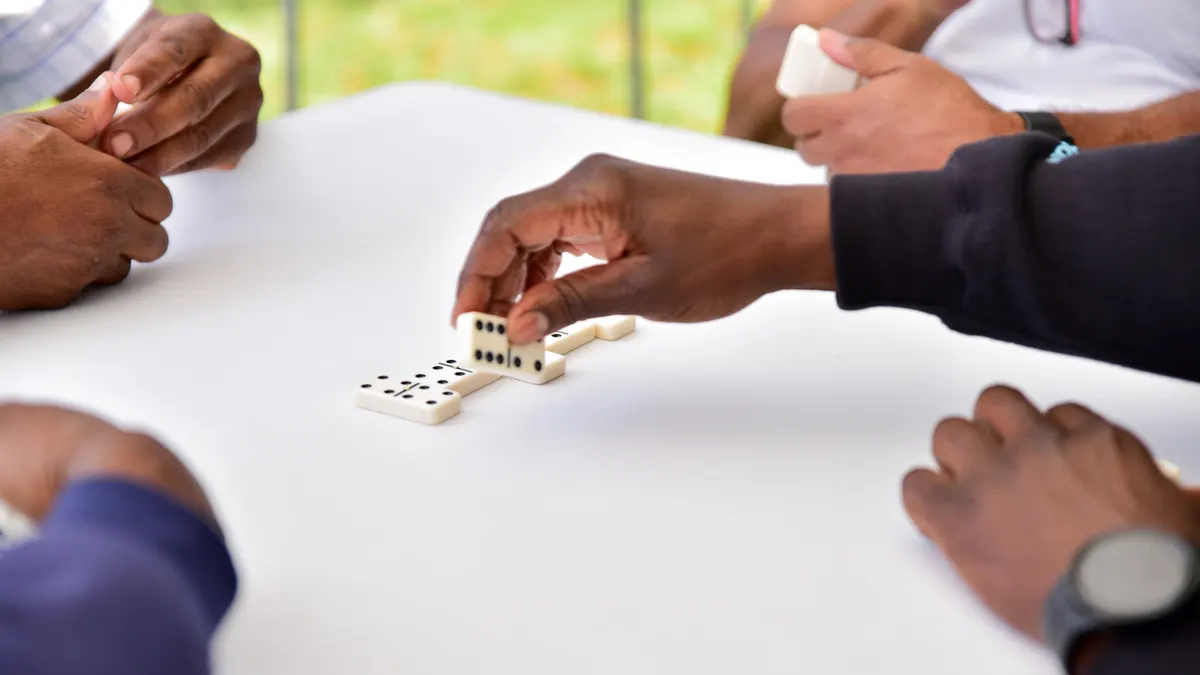
The unwritten rules at a domino table are the habits nobody explains until you break one: which way play goes round the table, who shuffles, how you show a pass, whether tiles go down gently or with a crack, and how much talking is allowed. Almost every table agrees on three of them: keep your tiles hidden, never signal your partner, and settle the house rules before the first tile is played. The rest change from one tradition to the next, and a newcomer who follows the habits of their own table at someone else's will look rude without meaning to.
This article sets out each convention, says which tradition it belongs to, and names the written source where one exists. Tournament rulebooks are the only place most of these habits are written down, so they appear often below. For the full tournament picture, see how tournament domino rules differ from a kitchen table.
Clockwise or counterclockwise: which way play goes
Dominoes is played clockwise at most North American and Northern and Western European tables, and counterclockwise at most Latin American and Caribbean partnership tables. There is no single correct direction; the tradition decides.
- Pagat.com's general rule. John McLeod's rules site says that when a game's rules do not state a direction, assume clockwise for games from North America, Northern and Western Europe and Russia, and counterclockwise for Southern and Eastern Europe and Asia.
- Latin American partnership. Pagat's page on the four-player partnership game played across Latin America says play is normally counterclockwise, and the turn to start each new deal passes to the right.
- Jamaican partner. Pagat records that play continues anticlockwise.
- FEMUNDO. The world championship rules of the Federación Mundial de Dominó do not say "counterclockwise", but the turn after the opening tile belongs to the player on the opener's right, which is the same thing.
- North American Block. Pagat's Block page passes the lead for the next round to the previous leader's left, the clockwise way.
If you sit down at a table you do not know, watch one turn before you play. If you are hosting mixed company, say the direction out loud before the deal.
Who shuffles, and who draws last
The shuffler is usually the person with the least to gain from cheating, and the shuffler takes their tiles last. Tables differ on who that person is.
- FEMUNDO names the player on the left of the person who will open. That shuffler always draws last; only the opener may reshuffle, and if they do, they draw last instead.
- The San Juan club tournament rules (Puerto Rico) give the shuffle to the side that lost the previous hand.
- Pagat's general guidance lets one player or all players mix the tiles, face down, until everyone agrees they are random, and adds that nobody may look at a face while shuffling.
At home the polite version is simple: shuffle face down with both hands, make it long enough that nobody can complain, and take your tiles after the others.
Standing, holding and hiding your tiles
Your tiles stay hidden from everyone, your partner included. Pagat's general rules call it cheating to let a partner see your tiles. The usual way to hold them is on their edges in a half-circle facing you, or in a rack.
Two habits follow from that:
- Do not rearrange constantly. FEMUNDO lets players place their seven tiles on the rack in one or two movements and then forbids rearranging. Shuffling your tiles in your hand after each play tells a watchful opponent where you are keeping a suit.
- An exposed tile is a problem for the person who showed it. Pagat says an accidental exposure may be ignored if it gives no one an advantage. Tournaments are stricter: a tile seen by the table becomes an "exposed" tile that must be played at the first chance.
Knocking or saying pass
How you show a pass is the convention that differs most visibly. At many home tables, and in pagat's partnership rules, you pass by knocking the table with a tile. In written tournament rules you say it.
- FEMUNDO: the word "pass", in a normal tone, is the only valid pass. Knocking or a gesture is a violation: a warning the first time, 40 points off the second.
- Confa (Colombia) seniors tournament, 2026: say paso out loud.
- San Juan club tournament: a pass is spoken.
A pass also carries information, and a false one (passing while holding a playable tile) is the most serious breach at any table. FEMUNDO takes 80 points and gives a yellow card; done on purpose, it costs the match. For what a genuine pass tells you, see what you can learn when a domino player passes.
Slamming tiles: tradition or bad manners?
Whether you slam a tile depends on whose table it is. Pagat's introduction to Caribbean domino games says the pieces are slammed down on the table rather than placed gently. Other domino communities treat the same act as bad manners.
- A 2003 Riverwest Currents report on a Milwaukee domino league quoted the co-owner of Club Caribe, which hosted its tournament: etiquette means players do not slam their dominoes or wander around the room.
- The Bogotá community games rules (IDRD, 2024) forbid striking the table with tiles.
- FEMUNDO asks for tiles to be laid smoothly and evenly, with the same hand each time.
A reasonable rule for a visitor: place the tile firmly and squarely, and let the regulars decide whether the closing tile gets a crack.
Table talk, gestures and the pause
No tradition allows partners to describe their hands to each other. The argument is about everything short of that.
- Jamaican partner (pagat): no talking or gestures to pass information, no telling your partner what you hold or want. Hesitating to show you had a choice, or playing at once because you had only one tile, is fair.
- Spanish-language partnership guides use the word pensada for a thinking pause and treat it as information anyone at the table may read.
- FEMUNDO wants hands under the table, eyes on the board, complete silence during a hand, and comments only between hands while shuffling or scoring. Unauthorised signalling earns a black card, which means expulsion.
- Pagat's general rule for all games: do nothing by word, expression or gesture to suggest anything about the tiles.
At a social table, banter about the score and the last hand is part of the game. What crosses the line everywhere is talk that points at a tile: "play your fives", a glance at an end, a tap beside a number. For more on what partners may legitimately read from each other, see how partnership dominoes changes the way you play.
Pace, and playing out of turn
Play at the table's pace. Long thinking on a forced move gives information away; rushing when you have a real choice is fine.
FEMUNDO sets 5 seconds when you have one tile or must pass, 20 seconds with a choice, and one minute for the play that blocks the game. The Lagos tournament rules in Mexico allow 20 seconds when there is a choice. Home tables have no clock, but the same idea holds: nobody should have to wait while a player studies a hand with one legal tile.
Playing before your turn is penalised in tournaments (FEMUNDO: 40 points, and the tile is exposed). Pagat notes one shared exception: when the last tiles are forced, many players lay them quickly without waiting for their turn.
A touched tile, and a finished hand
Two small rules save most arguments.
- A touched tile is a played tile in the San Juan club rules: once you pick a tile up to play it, you play it.
- Do not break up the board until the hand is scored. FEMUNDO requires the played tiles to stay as they are, and the unplayed ones to stay in front of their owners, until the points are counted and written down: 40 points off for anyone who mixes them early. At home it is simply how a disputed count gets checked.
Agree on the house rules before you start
The most important unwritten rule is to say the house rules aloud before the first deal, because no organisation governs dominoes and two experienced players can both be right about opposite rules. A one-minute agreement covers:
- Direction of play.
- Who opens the first hand and who opens after that (see which domino to open with).
- Scoring method and target (see how a domino game is scored).
- Who wins a blocked hand, and what happens on a tie.
- Whether you may draw or pass while holding a playable tile.
- Bonuses such as the capicú, and whether knocking or speaking counts as a pass.
Most of the arguments that end domino nights start with one of those six questions left unasked. If you are bringing someone new to the table, the common beginner mistakes are worth a read alongside this list.