
Dominoes / Rules
How do you play Matador dominoes?
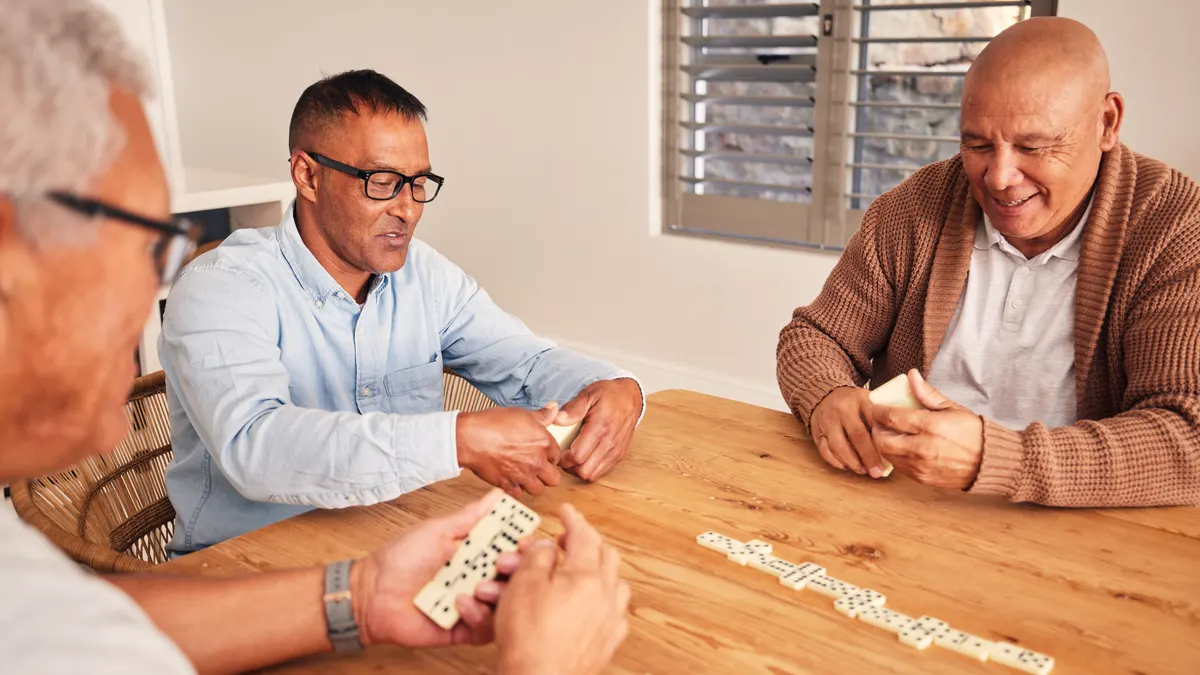
Matador is a line game played with a double-six set in which you do not match numbers: the two halves that touch must add up to seven. A 6 takes a 1, a 5 takes a 2, a 4 takes a 3. Four tiles, the matadors — [0-0], [1-6], [2-5] and [3-4] — can be played on any open end regardless of the sum. A blank at an end can only be covered by a matador. The hand ends when someone plays their last tile or nobody can move, and the player with the fewest pips left scores. Games usually run to 100 points.
That much every written source agrees on. The deal, the drawing rule and how the winner is paid differ from one source to the next, and the sections below say which source says what.
The seven rule, end by end
Every number from 1 to 6 has exactly one partner that makes seven, so each open end asks for one specific number:
| End shows | You need | Tiles that can answer |
|---|---|---|
| 6 | a 1 | 7 tiles carrying a 1, plus 3 other matadors = 10 |
| 5 | a 2 | 7 tiles carrying a 2, plus 3 other matadors = 10 |
| 4 | a 3 | 7 tiles carrying a 3, plus 3 other matadors = 10 |
| 3 | a 4 | 10 |
| 2 | a 5 | 10 |
| 1 | a 6 | 10 |
| 0 (blank) | a matador only | 4 |
So any end showing 1 to 6 can be answered by 10 of the 28 tiles, while a blank end can be answered by only 4. That gap is the whole game.
You play the tile with the needed half facing inward; its other half becomes the new end. If the end shows 5 and you play [2-6], the 2 touches the 5 and the 6 is now open, waiting for a 1.
Doubles are played in line like any other tile in the main rules (pagat, and Wikipedia citing Gyles Brandreth's Everyman's Indoor Games). A [3-3] needs a 4 against it and leaves a 3 open. No double except [0-0] adds up to seven, so [0-0] is the only double that is a matador.
What the matadors do
A matador can go on any open end, whatever number it shows, and you choose which half faces out. The next player must then make seven against that new end, or play a matador of their own.
Their main job is the blank end. Look at a tile like [0-5]: to play it normally, the 5 must face inward against a 2, which leaves the blank pointing out. No tile adds a blank to seven, so that end is now closed to everything except the four matadors. Every ordinary blank tile you play closes an end this way. That makes blanks a weapon and matadors the only key.
How often you hold the key, computed exactly for a double-six set:
| Hand size | No matador at all | Holding [0-0] | Two or more matadors |
|---|---|---|---|
| 5 tiles | 43.2% | 17.9% | 13.5% |
| 7 tiles | 29.2% | 25.0% | 25.3% |
With five tiles, a player has almost even odds of holding no matador, which is why closing an end with a blank so often forces a draw or a pass.
The deal and drawing: where sources disagree
There is no governing body for Matador, and the written sources give different deals:
- Pagat (John McLeod's rules site, page by Joe Celko) describes a four-handed game, in partnerships or as individuals, with 7 tiles each. Four hands of 7 use all 28 tiles, which leaves no boneyard, yet the same page discusses drawing. If you play four-handed with 7 each, decide at the start that a player who cannot move simply passes.
- Wikipedia, citing Brandreth, gives two to four players and 5 tiles each, with the rest as a boneyard.
- Gamerules.com gives 7 each for two players, 6 for three, 5 for four.
- The 1911 Encyclopaedia Britannica describes 7 each, the highest double leading, and drawing when you cannot make seven, with two tiles always left in the stock.
The lead goes to the highest double in Wikipedia, gamerules.com and Britannica. Pagat has players draw to decide who sets first, and notes that some groups make the leader set their highest double.
Drawing rules split three ways. Pagat says a player who could only play a matador may draw instead of using it, and that some sources let a player pass, while others make the player draw until they get a playable tile or only two tiles remain. Wikipedia makes you draw until you can play, then pass by knocking once the boneyard is empty, and records an alternative where you pass straight after drawing one unplayable tile. Agree on one before the first hand.
Scoring: two ways to pay the winner
The hand ends when someone plays all their tiles, or when every player has passed in turn. Everyone counts the pips left in hand, doubles in full. A [4-4] costs 8, even though it only showed a 4 when it was played.
Who scores, and how much, depends on the source:
- Difference (pagat, gamerules.com): the lowest total scores the losers' pips minus their own. If two players tie for lowest, nobody scores.
- Everything (1911 Britannica, main rule): in a blocked two-player game, the lower hand scores the pips of both hands. Britannica notes that some players count only the difference.
A worked two-player example: the hand blocks with you holding 8 pips and your opponent holding 19. Under the difference rule you score 19 − 8 = 11. Under the Britannica rule you score 8 + 19 = 27. In a race to 100 that is the difference between a long game and a short one, so settle it before the first hand.
With three players, Britannica says the two lower scorers usually team up against the leader. With four, pagat's four-handed game can be played in partnerships, and the general logic of blocked hands applies.
A worked opening
Two players, 7 tiles each, highest double leads (the Britannica and gamerules.com deal).
- You: [6-6] [3-5] [1-2] [0-4] [2-5] [4-4] [0-3]
- Opponent: [6-4] [1-1] [5-0] [6-2] [3-3] [1-6] [2-4]
- You lead [6-6]. Both ends show 6, so each needs a 1.
- Your opponent plays [1-1] on the left. Ends: 1 and 6.
- The 1 needs a 6, and you have none left. The 6 needs a 1: you play [1-2], 1 inward. Ends: 1 and 2.
- Your opponent plays [5-0] on the 2, the 5 inward. The blank now points out. Ends: 1 and 0. One end is closed to everything except a matador.
- You still have no 6, so the 1 is dead to you. You play your matador [2-5] on the blank and choose to leave the 5 out. Ends: 1 and 5.
- Your opponent plays [6-4] on the 1, 6 inward. Ends: 4 and 5.
- The 4 needs a 3: you hold [3-5] and [0-3]. You play [0-3], 3 inward, which closes that end with a blank. Ends: 0 and 5.
Your opponent can still answer: [6-2] or [2-4] fits the 5, and their [1-6] can go on the blank. But every closed end now costs them a matador or a tile they would rather keep, and you have spent your one matador to stay in the hand.
Variations worth knowing
- Bigger sets. Pagat gives the general rule: with a double-n set, ends add to n + 1, and the matadors are [0-0] plus every tile totalling n + 1. On double-nine the target is 10 and the matadors are [0-0], [1-9], [2-8], [3-7], [4-6] and [5-5]. On double-twelve the target is 13, with seven matadors.
- Crossways matadors. Pagat lists three versions. In one, reported by Joe Celko and found in Frederick Berndt's The Domino Book (1975), any matador may be played across the line, and the next player may match either of its ends. In another, said to be played in English-speaking countries, a matador on a blank must go crossways and the next tile on that end must put a blank inward. In a third, said to be Central European, the matador sits crossways with one end in line. None of these is the main rule; agree on it first.
- Other names. Pagat records that some books call it Russian Dominoes and that it is known in Germany as Kardinal domino. The name is the Spanish word for a bullfighter. Pagat calls it a Spanish game; no dated source for where it began was found, so treat any origin story with caution.
How to play it well
Pagat's strategy notes, with the numbers behind them:
- Hold [0-0] as long as you can. It is the most valuable tile in the set: it always has a play, and once placed it leaves a blank that only three matadors can then answer.
- Spend matadors late. A matador can turn any end into the number you want. Keep it until you can use it to leave a number your opponent has shown they lack, or to rescue a tile that otherwise has nowhere to go. The count of played tiles and passes tells you when that moment has come.
- Collect two numbers that make seven. A hand long in 2s and 5s can answer both a 5 end and a 2 end, and the tiles you play keep creating ends you can answer yourself.
- Use blanks to close an end on a player who is short of matadors. With five tiles in hand, a player has a 43% chance of holding none. With seven, 29%.
If you already play the block and draw games, Matador takes one hand to learn and a few to stop matching numbers by habit. The difference shows in how the hand is scored: the pips left in your hand still decide it.