
Dominoes / Teaching
How do you teach dominoes to a beginner in ten minutes?
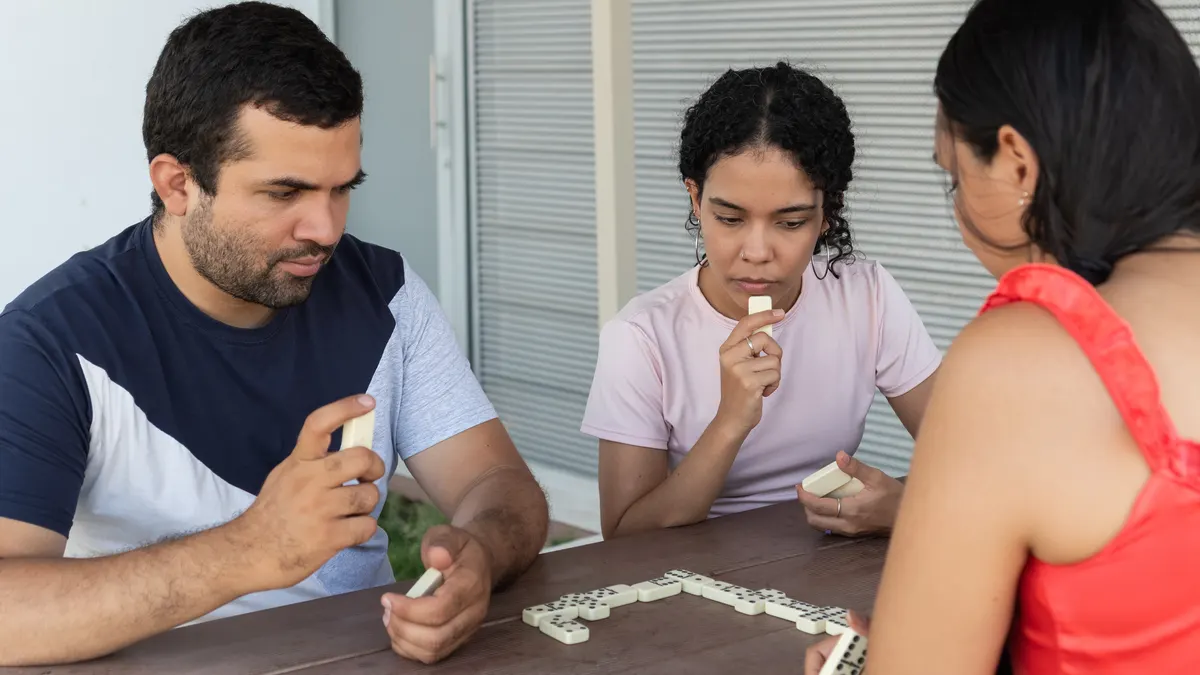
Teach the block game, explain only five things, and play the first hand face up. The five things are: what the tiles are, how a tile matches, what to do when you cannot play, how a hand ends, and who wins it. That is a complete game, and a new player can learn it in about five minutes of talking and five of playing. Everything else — drawing from the boneyard, scoring to a target, partnership signals, spinners — comes one rule per hand afterwards.
The mistake most people make when teaching is explaining the game they play, with every house rule, before the learner has touched a tile. The plan below does the opposite.
Start with the block game
The block game is the right first game because it has the fewest rules. On pagat.com, John McLeod's rules site, it is described as the simplest and most common domino game: deal the tiles, match ends, pass if you cannot play, and the hand stops when someone goes out or nobody can move. There is no drawing and no scoring during play.
Pagat's Block deals 7 tiles each for two players and 5 each for three or four, with the rest left face down and unused. If the learner is going to join a four-player partnership table — a common game across Latin America and much of the Caribbean — teach it the way that table plays instead: four players, 7 tiles each, all 28 dealt. The matching rules are the same; only the deal changes.
Teach the rules of the table the learner will actually sit at. Dominoes has no governing body, and a beginner taught one family's rules will be "corrected" at the next table. If you do not know where they will play, teach Block and tell them plainly that tables differ.
Minute 1: the tiles
A double-six set has 28 tiles. Each half shows a number from 0 (blank) to 6, and every pair of numbers appears exactly once, so there is one [6-4], one [3-0], and so on. Seven tiles are doubles, from [0-0] to [6-6].
The one fact worth saying out loud: each number appears on exactly seven tiles. There are seven sixes, seven blanks, seven of everything. A learner who hears this in minute one is already halfway to counting, which is what separates good players from lucky ones later (more on that here).
Turn all 28 face down and shuffle them with both hands. Let the learner do it.
Minutes 2–3: matching
Lay one tile in the middle, say [6-3]. The line now has two open ends, a 6 and a 3. A tile can be played on an end if one of its halves matches that end, and it is laid so the matching halves touch. Put a [3-1] against the 3: the ends are now 6 and 1.
Show two more things and stop:
- Only the ends count. Numbers in the middle of the line are finished with.
- Doubles go crossways in most block games, and a double still leaves the same number showing: a [1-1] on the 1 end leaves a 1 end.
Then hand the learner three tiles and ask where each could go. Three correct answers is enough.
Minute 4: passing and turns
Play moves round the table, usually to the left. On your turn you must play a tile if you can. If no tile in your hand matches either end, you pass. At many home tables you knock on the table to pass; in formal play, such as the FEMUNDO competition rules, you say "pass" and knocking is penalised. Tell the learner what your table does.
Say one more sentence: at almost every block table, playing when you can is not optional, and passing while holding a playable tile is the most common beginner foul.
Minute 5: how a hand ends and who wins
A hand ends in one of two ways:
- Someone plays their last tile. They have "dominoed" and win the hand.
- Nobody can play. The game is blocked. Everyone counts the pips (dots) left in their hand, and the lowest total wins.
Show the count with real tiles. If you are left with [5-2] and [4-0], that is 11 pips; if your opponent holds only [5-5], that is 10, and they win the block.
For the first game, that is all the scoring needed: win the hand or don't. How many points a hand is worth varies a lot by tradition — pagat's Block gives the winner the losers' pips minus their own, Jamaican partner scores one point a hand — and the guide to scoring covers those systems when you get there.
Minutes 6–10: one hand face up
Now deal a real hand, but play it with every tile face up. This is the single most useful teaching move: the learner sees why you play what you play, and you can stop on any turn and ask "where could this go?"
A two-player example, 7 tiles each:
- You: [6-6], [6-3], [3-1], [5-2], [4-0], [2-2], [1-0]
- Learner: [6-4], [3-3], [5-1], [5-5], [2-0], [6-1], [4-4]
You lead [6-6] (ends 6 and 6). The learner can play [6-4] or [6-1]; say they play [6-4] (ends 6 and 4). You play [6-3] (ends 3 and 4). The learner now has two choices — [3-3] on the 3 or [4-4] on the 4 — and this is the moment to point out that both are doubles and doubles are the tiles most likely to get stuck. They play [4-4] (ends 3 and 4). You play [4-0] (ends 3 and 0). The learner plays [3-3] (ends 3 and 0), then you [3-1] (ends 1 and 0)...
Talk through your own choices as you go — "I'm playing this because I have two more threes" — but do not correct the learner's strategy yet. In the first hand the only things to correct are rules: a tile that does not match, a pass with a playable tile, a play out of turn.
Then play a second hand normally, tiles hidden. That is the ten minutes.
What to leave out of the first lesson
Every one of these is real, and every one of them can wait:
- Drawing from the boneyard. Draw games add a rule about when you may draw, and traditions disagree on it: pagat's main draw rules let you draw even when you could play, while the Puerto Rican rules it records forbid it.
- Who opens. Draw for the lead the first time. Whether the [6-6] must open differs by table; the guide to opening explains the options.
- Scoring to a target. Pagat's Block plays to 100 for two players and 61 for three or four; partnership tables often play to 100 or 200.
- Spinners and scoring by fives. All Fives and Muggins count the ends during play, which is a second game on top of the first.
- Strategy. Counting, reading passes and holding back a suit come after the learner can play a hand without help. The list of what beginners get wrong is a good second lesson.
The order to add rules afterwards
Add one rule per hand, and only once the last one is automatic:
- Scoring and a target, using your table's system.
- Who opens, if your table has a fixed rule.
- Drawing, if your table plays a draw game.
- Partnership, if they will play in teams: your partner sits opposite, and their first tile usually shows their strongest suit. The partnership guide covers the rest.
- Variants, such as All Fives, Mexican Train or Chicken Foot — compared in the main domino games.
Small things that help
- Use a double-six set. Bigger sets mean bigger hands and slower first games; the guide to sets explains when a double-nine is worth it.
- Two players first, if you can. One opponent means fewer turns to wait through and every tile is easier to follow; the two-player guide covers that game.
- Let them win the first block by counting it themselves. Counting pips at the end is the moment the game starts to make sense.