
Dominoes / Culture
What is a capicú in dominoes, and which tables pay for it?
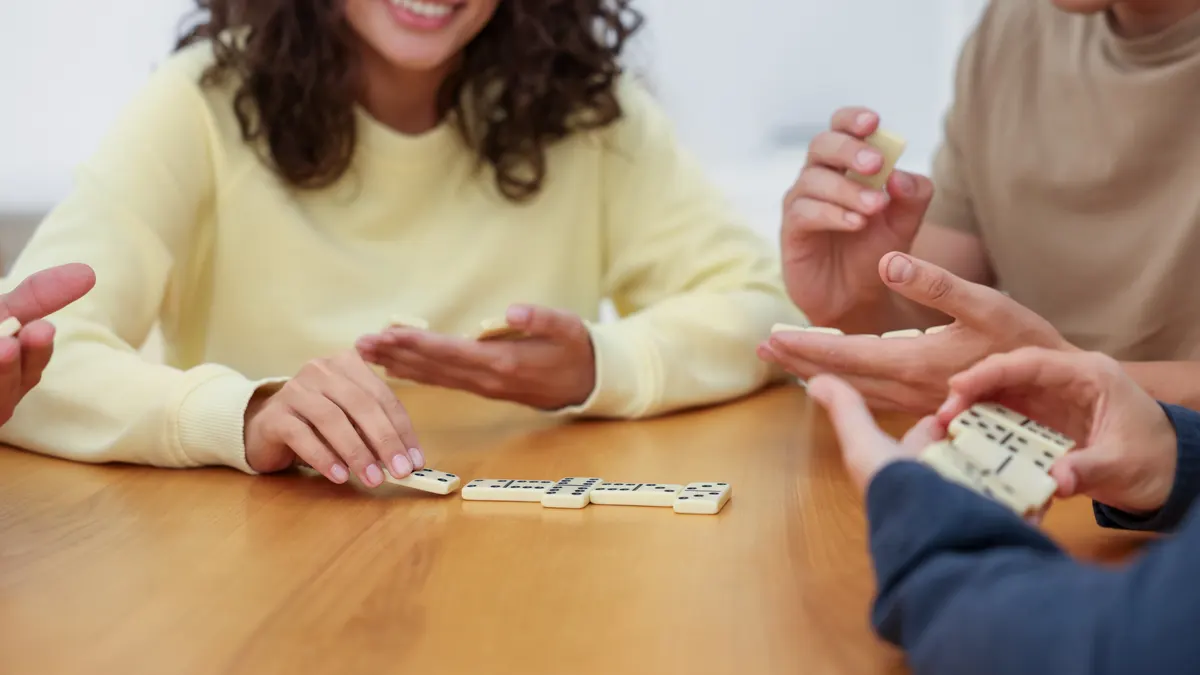
A capicú (also spelled capicúa) is going out with a last tile that could have been played on either end of the line. If the ends show 3 and 5 and your last tile is [3-5], that is a capicú. What it is worth depends entirely on the table. In the Puerto Rican game Quinientos it is a 100-point bonus. In Jamaican partner play a stricter version scores one extra point. Some tournaments state in writing that it earns nothing at all. There is no rule that covers everyone, so the only safe answer to "does capicú pay here?" is to ask before the first shuffle.
Where the word comes from
The Spanish dictionary of the Real Academia Española derives capicúa from the Catalan cap i cua, "head and tail". In everyday Spanish the same word describes a number that reads the same in both directions, like 1221. The domino meaning follows the same picture: the last tile joins the head of the line and its tail at once.
You will hear it at Spanish-speaking tables in the Caribbean, in Latin America and in their communities abroad. English-speaking tables mostly have no word for it, which is one reason it causes arguments when players from different traditions sit down together.
What counts as a capicú
The basic idea is the same everywhere it is played: the tile that ends the hand fits both open ends. The details are where tables part ways.
- Doubles usually do not count. If both ends show 4 and your last tile is [4-4], it fits both ends, but the Puerto Rican rules recorded on pagat.com call that a dominao and pay no bonus. The Jamaican rules on pagat exclude doubles too, and Spanish-language Wikipedia records the same exclusion for Dominican tables.
- Same-number ends are a grey area. If both ends show 2 and your last tile is [2-6], it can technically go on either end. The Quinientos rule as pagat words it ("can be played on either end") would seem to allow it. The Jamaican rule requires two different numbers. Many players only call it a capicú when the two halves of the tile match two different ends. If your table pays for it, decide this case in advance.
- Some tables want it to be forced. The Jamaican version, described below, only pays when the last tile is the only tile anyone could still play.
What each tradition pays
| Tradition | Name | Condition | Worth |
|---|---|---|---|
| Quinientos (Puerto Rico, game to 500) | Capicú | Last tile is not a double and fits either end | +100 |
| Quinientos | Dominao | Last tile is a double that fits either end | No bonus |
| Quinientos | Chuchazo | Going out with the double blank as your only tile | +100 |
| Jamaican partner (to six-love) | Key bone | Both ends are "hard" with different numbers; the only playable tile is your last | 2 points instead of 1 |
| Dominican informal play | Capicúa | Non-double last tile fits both ends | +25 or +30, by house rule |
| Some eastern Cuban play | Capicúa | Capicúa variant of the game | Double the hand's points |
| San Juan club tournament | — | — | No bonus, stated in writing |
The first four rows come from pagat's partnership and Caribbean pages. The Dominican and Cuban rows come from Spanish-language Wikipedia, which does not cite a source for them, so treat them as a record of what some tables do rather than as settled rules.
Two details in that table deserve a closer look.
The Jamaican key bone is much stricter. In Jamaican partner play, a number becomes a "hard end" when seven of its eight halves are already on the table, so only one tile carrying it remains. When both ends are hard and show different numbers, exactly one tile in the game can be played: the one that joins them. Go out with that tile and your team scores 2 instead of the usual 1. A Quinientos capicú only needs your last tile to fit; a key bone needs it to be the last tile that could fit.
The chuchazo is a separate bonus. Some Puerto Rican tables pay 100 for going out with the double blank whatever the ends show; others pay it only when one end shows a blank, and treat a blank at both ends as a plain dominao. It sits next to capicú because both reward the manner of going out, not the pips.
A related idea turns up in Milo, a partnership game pagat records in parts of Africa and Indonesia: if the tile that goes out leaves both ends showing the same number, the team scores 2 points. It is a cousin, not the same rule.
Tournaments that refuse it
Club and federation rulebooks often leave capicú out. The tournament rules of the Club Náutico de San Juan and Caparra Country Club, played to 200 points, say plainly that no extra points are given for capicú or any other play. The competition regulations of FEMUNDO, one of several international domino federations, list how hands and blocks are scored and mention no bonus of any kind. Tournament play tends to want a score that depends only on pips, and the earlier piece on tournament rules shows how far those rulebooks go to remove anything a table could argue about.
How often it happens
We simulated 300,000 four-player partnership hands with a double-six set, seven tiles each, [6-6] leading and every player choosing at random among legal plays. Three quarters of hands ended with someone going out; the rest were blocked.
| Result | Share of all hands |
|---|---|
| Capicú, two different end numbers | 11.7% |
| Last tile fits both ends, but both ends show the same number | 2.1% |
| Dominao (a double that fits both ends) | 2.9% |
So with careless play roughly one hand in nine ends in a clear capicú. Real players are not random, and these are illustrations of the arithmetic, not measured rates at real tables. They still make the point about scale: in the same simulation, a hand that ended with someone going out left about 24 pips in the other three hands on average. A 100-point capicú bonus is worth roughly four ordinary hands. At a Quinientos table, that is not decoration. It is a large part of the game.
Can you set one up
Less than you would hope in a four-player game, and more in a two-player one.
With two tiles left, a capicú is only possible if your two tiles share a number. Say the ends are 1 and 6 and you hold [1-4] and [4-6]. Play [1-4] on the 1 and the ends become 4 and 6, which is exactly your last tile. Play [4-6] on the 6 and the ends become 1 and 4, which also works. If instead you hold [1-4] and [3-6], whatever you play, your last tile matches only one end.
The catch is what happens next. In a partnership game three players move before you do again, and each of them can change an end. Your partner may help; your opponents, if they have been counting, will see what you are waiting for. In the simulation, a player who always chose the capicú-leaving play at two tiles raised the capicú rate only from 11.7% to 12.8%. In two-player dominoes, only one opponent moves in between, and the set-up is worth far more.
There is a defensive side to the same fact. A last tile that fits both ends is also the hardest last tile to stop: one play can change only one end, so holding it means one blocking move is not enough. That is true whether or not your table pays a bonus.
Practical rules for the table
- Never give up a safe way out to chase the bonus. A won hand is a won hand; a capicú that does not arrive can cost you the hand.
- When two plays are otherwise equal, leave the capicú open. It costs nothing and, at a bonus table, it can be worth more than the hand itself.
- Watch the opponent with one tile. If the ends are 2 and 5 and nobody has seen [2-5], ask yourself who holds it. In a partnership game that question can decide which end you cover.
- Agree on the edge cases before you start. Doubles, same-number ends, whether the bonus goes to the player or the team, and whether it counts in a match-winning hand. Each of these has been argued at a real table.
The scoring of a hand is the thing traditions disagree about most, and capicú is one of the clearest cases: the same last tile can be worth nothing, one point, or a hundred, and every one of those tables is playing correctly by its own rules.