
Dominoes / Equipment
What are dominoes made of, and does it matter?
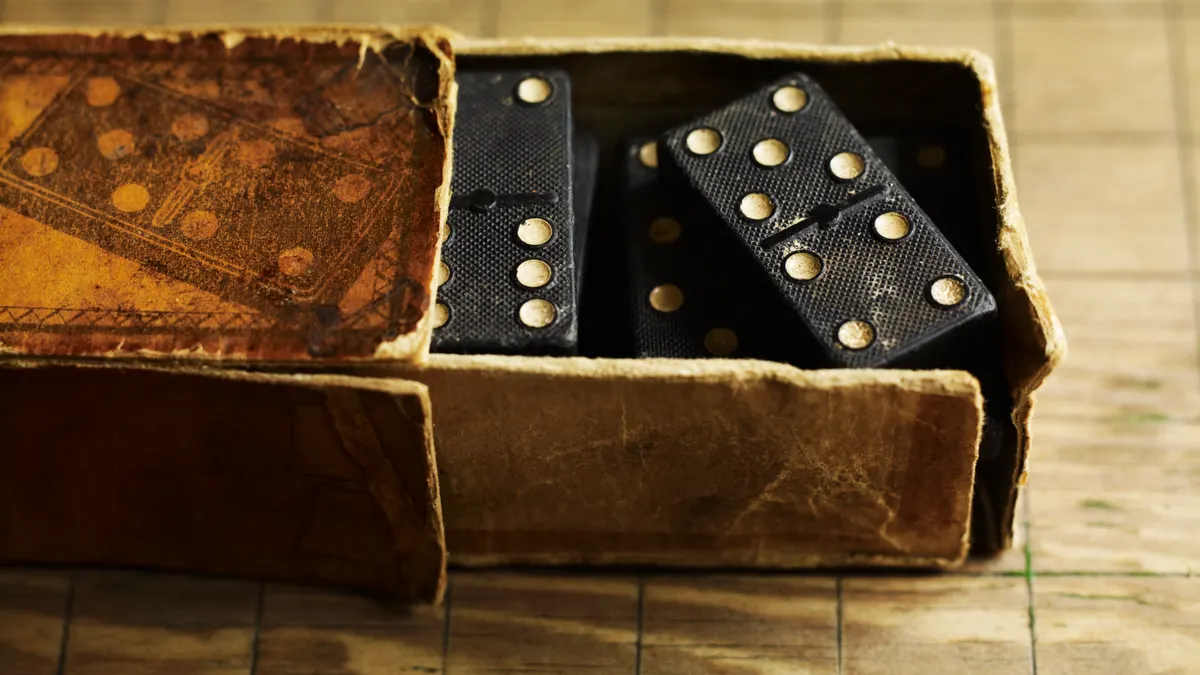
Most dominoes sold today are plastic: Wikipedia lists ABS, polystyrene, Bakelite and other phenolic resins, and retail sets are often labelled urea, melamine or acrylic. Older European sets were bone or ivory, usually glued to a backing of ebony or another dark hardwood and held together by a small brass pin through the middle. Wood, stone, metal and even card sets also exist. The material does not change a single rule, but it does change how a set sounds, how it stands on its edge, how long the pips stay readable and how easy it is to cheat by accident. Here is what each material is, with sources, and what to look for if you are buying.
Bone and ebony: the classic European set
The traditional European set is a thin bone face glued onto a black wooden back. The Victoria and Albert Museum's note on a 1930s English set says early dominoes were made this way, and that the wooden backing let the tiles stand on their edges. Museum Wales holds a 55-tile double-nine set (item F99.38) whose record describes exactly that construction: bone glued to an ebony backing and "fastened in the centre with a brass sprig."
Earlier sets could be solid bone or ivory. Joseph Strutt's Sports and Pastimes of the People of England (1801) describes the game as recently imported from France and the set as 28 pieces of ivory or bone with white faces. Bone sets carved by French prisoners of war in England in the early 1800s survive in museums: the Horniman Museum in London holds a set of 28 bone dominoes in a painted box (object 9.606), labelled as made by French prisoners at the beginning of the 19th century.
At the table, old bone-and-ebony sets tend to be smaller and lighter than modern tournament tiles. The bone face is a separate layer, so old tiles can lift or crack at the edge, and a single loose face makes that tile recognisable from behind. Check every piece before playing with an antique set.
The brass pin: fastener first, "spinner" second
The metal stud in the middle of many tiles started as part of the construction. In bone-and-ebony sets like the Museum Wales one, the brass pin is what fastens the bone face to the wooden back.
Modern plastic sets do not need a fastener, but many keep the pin. Wikipedia calls it a spinner or pivot. Sellers say a rounded pin lets tiles turn easily when they are shuffled face down and keeps the faces off the table; treat that as their description rather than a tested claim. Whether you like pinned tiles is a matter of taste.
Do not confuse the pin with the other meaning of "spinner." In All Fives and some other games, the spinner is the first double played, which can be built on from all four sides. A set "with spinners" in a shop listing means metal pins, not a rule.
Plastic and resin: almost every set sold today
Modern commercial sets are almost all moulded plastic. The V&A holds a mass-produced 1930s English set of 28 Bakelite dominoes in a cardboard box, made by a firm called Empire. Today's sets are sold under several plastic names:
| Label on the box | What it usually means at the table |
|---|---|
| Urea, melamine | Hard thermoset plastics, common in heavier sets sold as "tournament" or "professional" (Pressman, for one, sells a urea tournament set) |
| Bakelite, phenolic | Mostly older sets, like the V&A's 1930s Empire set |
| Acrylic, ABS, polystyrene | Moulded sets of every weight; often coloured or translucent |
| Card | Very cheap and light; Wikipedia notes they can be upset by a breeze |
The labels are not standardised. Two sets both sold as "tournament" can differ in weight and thickness, and many listings do not name the plastic at all. If the material matters to you, ask the maker or seller.
How the pips are made matters more than the plastic. A 2000 Austin Chronicle profile of Puremco in Waco, Texas — then described as the last domino factory in the United States — described plastic poured, cut and polished, then the pips drilled by computer-controlled machines and painted. Drilled and painted pips are recessed into the tile. Pips printed onto the surface sit on top of it, where years of shuffling can wear them.
Wood, stone, metal and other sets
Wikipedia lists stone (marble, granite, soapstone), woods such as ash, oak, redwood and cedar, metals such as brass and pewter, ceramic clay and glass. These sets feel more substantial and cost more. They are mostly gifts or display pieces: wood can swell and chip, stone and metal are heavy and loud, and glass breaks. For a weekly game, they are usually less practical than a good resin set.
Chinese dominoes are a separate tradition with a different set. Wikipedia, citing Stewart Culin, says traditional Chinese tiles are ebony, longer and narrower than European ones — about 67 mm long, 22 mm wide and 9.5 mm thick — with red and white pips, and a set has 32 tiles rather than 28. The history of both sets is in where dominoes came from.
Size and weight: the part you feel at the table
A Western domino is twice as long as it is wide, so a double can be set crossways. Beyond that, sizes are named by sellers, not by any rulebook. One long-running Mexican Train retailer lists these approximate sizes:
| Size name | Length × width × thickness |
|---|---|
| Mini | 1 3/16 × 9/16 × 3/16 in (30 × 14 × 5 mm) |
| Standard | 1 7/8 × 15/16 × 1/4 in (48 × 24 × 6 mm) |
| Professional | 2 × 1 × 3/8 in (51 × 25 × 10 mm) |
| Jumbo | 2 × 1 × 1/2 in (51 × 25 × 13 mm) |
| Tournament | 2 3/16 × 1 3/32 × 1/2 in (56 × 28 × 13 mm) |
Thickness is the number that matters most. A thick tile stands steadily on its edge in front of you without a rack, which is how many home tables hold a seven-tile hand. Thin tiles fall over and show their faces, and an exposed tile is a penalty in formal play (see tournament rules). Heavy tiles also make the sound people associate with the game: a hard tile on a wooden table. Whether slamming is welcome depends entirely on the table, as the unwritten rules article explains.
No international rulebook we have read fixes a material or a size. FEMUNDO's English competition regulations (nine pages) say how tiles are shuffled, drawn and placed on the lectern, but nothing about what they are made of or how big they are.
Colour and numbers on bigger sets
On a double-six set, plain black or white pips are easy to read. On double-nine and double-twelve sets, counting nine, ten or twelve pips at a glance is slower, so many sets give each number its own pip colour. Wikipedia notes that very large sets sometimes use numerals instead of pips. Colour helps in train and foot games, where you scan a long hand for one number; it matters less in a seven-tile line game.
What to check before you buy
- The set size your game needs. Double-six for block, draw, All Fives and partnership games; double-nine for Cuban-style partnership and Chicken Foot; double-twelve for Mexican Train.
- Thickness. The "professional" thickness of about 3/8 inch (10 mm) or more if you want tiles to stand steadily without racks.
- Drilled pips. Recessed and painted pips last longer than surface print.
- Identical backs. Every tile should be indistinguishable face down. A chip, a scratch or a different shade on one back means everyone at the table can learn that tile.
- Pins, if you want them. They change the feel of a shuffle, not the game.
- A count. Lay the set out face up and check every tile is there once: 28 for double-six, 55 for double-nine, 91 for double-twelve. A missing or duplicate tile breaks the arithmetic behind counting played tiles.
What matters for players
The material changes no rule: a card set and a marble set play the same game. For play, three things matter more than the material itself: tiles that stand up, backs that give nothing away, and pips you can read at a glance. A mid-weight resin set with drilled pips does all three. Antique bone-and-ebony sets are worth owning for their history, but play with them gently, and check every back first.