
Dominoes / Strategy
How much of dominoes is luck? The arithmetic of the deal
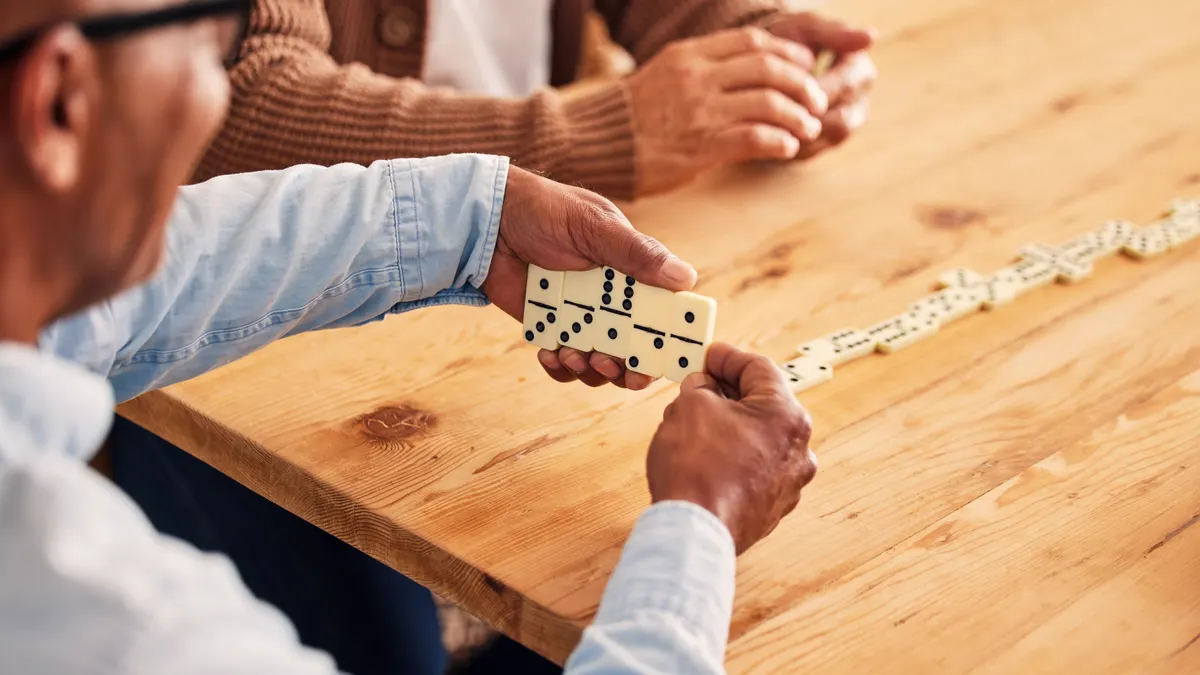
Over a single hand, a lot: the deal decides how many doubles you hold, whether you have a long suit, and how many pips you are carrying, and a bad deal can lose a hand no matter how well you play it. Over a match, much less. Every tile played and every pass turns guesswork into counting, and small edges repeat across dozens of hands. How much luck your game has also depends on the rules — above all, whether every tile is dealt or some stay face down all hand.
All the numbers below are exact. They come from going through every one of the 1,184,040 possible seven-tile hands from a double-six set, not from a simulation or a rule of thumb.
What the deal hands you
A double-six set has 28 tiles, seven doubles, and seven tiles carrying each number. Deal yourself seven and this is what to expect.
Doubles. The most likely hand holds two of them.
| Doubles in hand | Chance |
|---|---|
| 0 | 9.8% |
| 1 | 32.1% |
| 2 | 36.1% |
| 3 | 17.7% |
| 4 or more | 4.3% |
About one hand in five has three or more doubles, which is the usual "bad hand" complaint: doubles only match one number, so they are hard to get rid of.
Your longest suit. A suit here means a number — all the tiles that carry a five, say. In 63.5% of hands your longest suit is three tiles. In 26.8% it is four, and in 2.7% it is five or more. Only 7.0% of hands have no suit longer than two. So a hand with four of one number is good but not rare: you will see one roughly every fourth deal. Five of a number is about one deal in 37.
Missing numbers. 57.7% of hands hold no tile at all of at least one number. Any given number — fours, for example — is missing from 9.8% of hands. That is the chance you will be unable to answer that number from the very first turn.
Pips. The average hand carries 42 pips, with a standard deviation of 7. The lightest possible hand has 15; the heaviest has 69. Roughly two hands in three fall between 36 and 48 pips. About 18% carry 35 or fewer, and about 15% carry 50 or more.
How much a bad deal costs depends on the scoring
A heavy hand is only a problem if pips are what your table counts. In games scored by the pips left in losers' hands — the North American block and draw games, and the partnership games pagat.com describes for Mexico and Colombia — a hand of 55 pips that gets caught is a large gift to the other side. In Jamaican partner play, where a hand is usually worth one point regardless of pips, the same tiles matter only if the hand blocks. The guide to scoring sets out the three systems side by side.
So the same deal is "unlucky" at one table and harmless at another. Before you blame the tiles, check what they were going to cost you.
Unseen tiles, and where they can be
Once you have looked at your hand, every tile you cannot see is somewhere. Where it can be depends on how many tiles were dealt.
Four players, seven each. In the partnership games recorded at pagat.com, including Jamaican partner and the Latin American game, all 28 tiles are dealt. Each tile you do not hold is in one of three hands, so at the start each one has exactly a one-in-three chance of being with your partner.
Take a worked case. You hold four of the seven fours. Three are out, spread over three hands of seven:
- a given player holds none of them 27.4% of the time;
- one player holds all three 7.9% of the time.
So the most likely picture is that the three fours are split, and roughly one time in four a particular opponent cannot answer a four at all.
Two players, seven each. In the two-player draw game, 14 tiles stay in the boneyard. Each of the 21 tiles you cannot see is in your opponent's hand with a one-in-three chance and in the boneyard two times in three. Counting still works, but it tells you what is possible rather than where a tile is.
A pass turns odds into near-certainty
Counting is useful. A pass is better, because it removes a whole hand from the calculation.
Stay with the four-player partnership game. Three fours are unseen, a four is showing on one end, and the player on your left knocks. In a block game that player now holds no fours, so all three are with your partner or the player on your right.
If those two hands each hold five tiles at that point:
- the chance your partner holds at least one four is 91.7%;
- the chance one of the two holds all three is 16.7%.
Before the pass, a one-in-four chance that a given player was out of fours was a guess. After it, you know one player is out, and you can be more than nine-tenths sure your partner can follow you. That is how a good player turns a lucky-looking play into a routine one. The article on what separates a good player covers reading passes in more detail.
Tiles nobody plays add luck nobody can count
Some games leave tiles out of play for the whole hand. pagat.com's Block game gives five tiles each to three or four players and puts the rest aside unused; with four players, that is eight tiles that never appear.
From your seat, 23 tiles are unseen. Each one is in a given opponent's hand only 21.7% of the time and out of play 34.8% of the time. If three fours are unseen, there is a 3.2% chance that none of them will ever be played, and you cannot know until the hand ends.
That is real luck that no amount of counting removes, because a tile that is out of play is never revealed. Partnership play, where all 28 are dealt, has no such blind spot; pagat.com calls it one of the more skilful forms of dominoes. Neither format is wrong; they simply put luck in different places. The guide to the main domino games compares deal sizes across variants.
Why the long match belongs to skill
None of this means the better player wins every hand. They win a few more of them, and the length of the match does the rest.
As an illustration only — no one has measured real win rates for domino players — suppose one side wins 55% of hands against another. Here is how often it wins a majority over a run of hands:
| Hands played | Wins 55% of hands | Wins 60% of hands |
|---|---|---|
| 1 | 55.0% | 60.0% |
| 9 | 62.1% | 73.3% |
| 25 | 69.4% | 84.6% |
| 51 | 76.4% | 92.6% |
| 101 | 84.4% | 97.9% |
A 55% edge is barely visible across one evening. Across a season of weekly games, it decides who finishes on top. That matches what anyone who plays at a regular table notices: the same people tend to win, even though anyone can win tonight.
Real matches are not simple runs of hands — a game to 100 pips, a race to six or a match scored by fives all weight hands differently — but the direction is the same. The more hands it takes to settle a match, the less the deal decides.
What to take to the table
- Expect two doubles and a three-tile suit. That is an ordinary hand. Four of one number is worth building around; it turns up about one deal in four.
- Count one number. With seven tiles of each, you only need to subtract.
- Use the one-in-three rule. In a four-handed game where all 28 are dealt, every unseen tile starts with an even chance of being in each of the other three hands. Every pass and every play moves those odds.
- Know where the dead tiles are. If your game leaves tiles out of play, accept that some hands cannot be read, and do not over-trust your count.
- Judge yourself over many hands. One hand tells you about the deal. Fifty tell you about the player.